Sunday, 30 June 2013

Lake District Training Weekend

Oh boy, life has been so busy lately.  I've not had any time to update this blog for weeks.  I'm going to gloss over much of what happened in the last 4 weeks.  Two weeks ago I had a fun run around the Royston hills with a bunch of guys and girls.  I'd never met some of the runners before, and all those who were new to me had never been to Royston before, so they were in for a surprise.  The terrain is nothing like what you find in Cambridgeshire.  It's literally just across the county boundary and had some seriously steep hills, but none are particularly high.  Still, it makes a nice change from the flat countryside right on our doorstep.

Last weekend I should have run the Malvern Midsummer Marathon, but I decided to abandon instead.  I was trying to kill tow birds with one stone and also visit an old friend in Shropshire.  It's not a part of the world that I know that well and I thought I'd have about a 40 minute drive to the start of the marathon from my friend's house.  After more detailed planning it turned out it would take 1 hour 20 minutes, or thereabouts.  I thought about what time I'd need to get up and set off on the Saturday morning and realised just how unsociable this would be, especially as I hadn't seen my friend in two years.  So I decided to abandon and to be more sociable instead.  So Ruth and I spent a couple of days walking and exploring Shropshire with my old friend Janet instead.  All I can say is that the Shropshire countryside has to be one of the best kept secrets in Britain.  It was stunning.

I've also splashed out and bought myself a new Suunto Ambit 2 GPS watch.  It is much more powerful than my old Garmin 405.  It might even be more clever than me.  I think it will take a long time for me to learn all its features.  It's taken the last two weeks just to get to grips with its basic features.  I've managed to change the screens to give me the data that I want.  The great thing about this watch is that you can adjust the GPS update rate to conserve the battery life, and if you have the update rate as once every 60 seconds then the battery should last 50 hours.  Obviously, you lose accuracy, but a 50 hour battery life will be great for really long ultra marathons were your pace is so slow that having the updates every 60 seconds isn't the end of the world.  Other great features include being able to get a grid reference reading for where you are, useful if you're ever lost! You can also programme in a number of grid references and then have the watch help you to get to those points.  How useful is this?  Well if you're fell running and need to find a hill top in very poor visibility then the watch can guide you there.  The watch will also display your altitude, which my Garmin didn't do.  This is really useful when you're climbing a mountain and would like an idea of how far you are from the top.  

I've just spent the last few days in the Lake District trying to do some serious training ready for the 50 mile Swiss ultra marathon I'll be doing in August and my new watch proved to be a very valuable tool.  I drove up to the Lakes on Thursday.  As the weather forecast for Friday was awful I decided to try and squeeze a run in Thursday afternoon.  I was camping at Castlerigg Hall Farm, just outside Keswick and though that i run up to Great Dodd would be feasible in one afternoon.  It probably would have been if it hadn't been so cloudy and pouring with rain just as I reached the hardest part of the climb.

From the campsite it was pretty much all uphill running to the base of Clough Head, which I thought I could run over on my way to Great Dodd.  The route up to Clough Head was a steep slog without the benefit of any track.  From the start of the climb it wasn't possible to see any peaks due to the low cloud, but I thought so longs I keep going up I should be fine.  Many minutes later I found myself on a peak but checking the altitude with my new watch I realised it was too low to be Clough Head, what I had climbed was Threlkeld Knotts.  Checking the map I could see that the direct route to Clough Head would involve a very steep scramble up a scree slope, either that or head back down and around the scree.  At this point it was pouring with rain, my glasses were covered in rain drops making visibility even worse and it was cold.  So I decided to abandon Great Dodd and head back down. Before returning to the camp site I made a detour to go and see Castlerigg Stone Circle.  As it was still pouring with rain I didn't bother taking any photos, but the monument was worth the detour even in the rain.

Friday was such a complete washout that I spent most of the day shopping in Keswick and sampling three tea shops.  I also drove an hour south to Cartmel to spend the late afternoon and evening visiting a friend who used to be one of my clients.  Her husband is now the vicar at the very impressive Cartmel Priory.  Here's a photo from Google.


Thankfully, Saturday was a dry day, although with low cloud for the first part of the day.  I had also planned to make this trip a recce for doing the Bob Graham Round sometime.  If you don't know what the round is then either look it up on Wikipedia, read Feet in the Clouds by Richard Askwith or look at this website: http://www.ukhillwalking.com/logbook/r/?i=145

Any way, the first stage of the Bob Graham takes you from Keswick up Skiddaw.  Pretty much 800m of climbing to the summit at 931m.  This part is all on good, well marked trails.  From the summit of Skiddaw the Round goes down the north face of Skiddaw to Blake Hill then due east to Hare Crag, then north east to Great Calva.  I had planned to do all this and more.  However, the descent from Skiddaw to Hare Crag was over such rough ground that I found it hard enough to walk let alone run.  The way up to Great Calva crossed the Cumbrian Way, which I had walked several years ago.  The route up to Great Calva and ten off it again was also over rough ground with no trail.  This would have been great as a recce of the Bob Graham Round, but it wasn't really helping me to train for the Swiss ultra marathon.  Once I reached the Cumbrian Way I decided to change my plan, run back towards Keswick and then up to the top of Skiddaw again and then back down on the same path.

The route down from Skiddaw, just about under cloud still.
Doesn't look like much, but it was rough and quite steep.

On the Cumbrian Way heading back towards Keswick.

Nearing the top of Skiddaw for the second time in one day.
Little man to the left and Derwent Water below.

Heading down Skiddaw's stony trail.
It would have been nice to have gone further afield and seen more of the Lake District, but my main priority was to train.  By the end of the day I had climbed 1850m and covered about 20 miles. The Swiss ultra will climb a total of 5000m over 50 miles.  My day running in the Lakes added a lot more perspective to what I will be doing in August.  I also realise that the Swiss ultra is going to be a lot harder than I had originally thought.  Between now and then I also have the dread of the 24 hour Thunder Run to contend with.

I also spent much of my two runs in the Lakes practising using my trekking sticks.  What I found was that using sticks helps save your legs when you are reduced to walking fast up steep hills.  When running on the flat I have observed that many ultra runners carry their sticks in one hand.  I tried this but I found it really messes with my running efficiency.  You do use your arm swing to help with your running efficiency, but having something in one hand means you can't swing that arm as well.  I felt very uneven and wondered if this uneven running could lead to injury.  I tired to swap from one hand to the other and found that I great prefer to carry my sticks in my left hand.   I also tried to have one stick in each hand, but this made matters worse.  It just didn't feel natural to run with something in both hands.  I also found I didn't like having my sticks in my hand on descents.  Some people have told me they're great for balance and also good when the trail is slippery.  Using them to prevent falls when the descent is wet I can understand, but I didn't find that they helped my balance.  I opted to keep my sticks in my backpack as much as possible and to only get them out on really steep climbs, such as going up Skiddaw.  I might waste time putting them away and getting them out again, but for me the time wasted doing this will be made up because I can run better without having the sticks in my hands.

The weekend was also a great test for my Salomon Speedcross shoes.  I can conclude that they are great for a long days run on trails and cross country.  They grip really well on gravel trails, mud and grass.  However, if you have to go across wet moss covered rocks, which I did at times, then you might as well be wearing ice skates.  

I think what I really learnt from the weekend is that I need to do a lot more hill reps and could probably do with strengthening my legs more by doing a lot more squats.  So that is what I aim to do over the coming weeks.

Sunday, 2 June 2013

Fen Drayton 12 Hour Night Run

Last night's 12 hour run is officially the hardest thing I've ever done.  Just before 8pm 39 individual runners and 3 different relay teams gathered in the car park of the RSPB nature reserve at Fen Drayton for the briefest of briefings regarding the 12 hour night run.


Runners gathered for the briefing.
There were a few familiar faces.  Ex-rowing crew mate Richard Youell was there, as were two familiar park runners.  I was greatly surprised to see Ken, an american that I ran with during the 3-day Thames Tow Path run last September.  He was visiting the UK once again and decided to do this run during his visit, quite an amazing coincidence given the size of the field.

The run would take place on a rectangular loop around one of the man made lakes at the nature reserve, with one edge of the rectangle also running alongside the river ouse.  The loop was 2.2 miles long, so we were going to get to know it really well over the next 12 hours.  Every dip, tree root, rabbit hole and over hanging branch would be noted and remembered for all subsequent laps.  Still there was something nice about running around one small loop and experiencing it as the light levels changed.  Running through the night and into the sunrise was quite a magical experience, which I was able to appreciate despite being in pain.


Running in small groups over the first couple of laps.
 

We managed to run for almost 2 hours in daylight before it was time to don head torches for the night run.  This would be the first time that I have ever run completely through the night, and I was looking forward to making it through to sun rise.  I was trying to run very conservatively and by midnight I had just completed my first marathon with 8 hours left to go.  I then had a short break to grab a burger.  My main criticism would be that the food provided by the organisers didn't really match what I'd want to be eating on such an event.  I want cake, fruit, malt loaf any maybe a cheese sandwich.  The burger didn't quite sit well with me.


Sunset over the River Ouse.

Running through the night.
I managed to run reasonably well over the next 2 hours, but I was taking very short walk breaks by this stage.  I was also aware that I hadn't eaten as much as I normally would during an ultra marathon, so I stopped to make myself a peanut butter sandwich in a hot dog roll.  I only managed to eat about a third of it before I started to gag.  Again, it just wasn't working for me.  I decided at that point I'd try to make it through the night eating just the couple of Mars bars I'd brought with me.  I really wish I'd also brought my own malt loaf and bananas.

The next 6 hours were a serious hard slog.  Given that I'd run 26 miles in the first 4 hours, I then did about 12 miles in the next 2 hours and then 17 miles in the last 6 hours (this was with lots of stops and I think the organisers forgot to record one of my laps - I believe I did 57.2 miles in total).  I had to walk large chunks over the last six hours.  In hindsight I suspect I partly struggled because I wasn't eating enough.  I also don't think I'd recovered enough since the North Downs Way 50.

At one point I stopped on a deserted stretch of path and turned my head torch off so I could admire the night sky.  It was a clear night and we rarely get to admire the stars in such a perfectly unlit environment.  On one of my laps I managed to startle a small dear, who stood froze in my head torch as I approached it.  I got to within 6 feet and it just slowly ambled off the path to get out of my way.

At 3am, after 7 hours, my legs felt as if someone had been hitting them with bamboo sticks all night.  The course was pancake flat, which always fatigues my legs way more than an undulating run.  The muscles in the legs are work in exactly the same way hour after hour with no respite.  At least on a hilly course the workload in the different muscle groups changes all the time.  I had to really dig deep and kept on telling myself that my main goal was to make it until sun rise.


Not long until sunrise.
The sky was noticeably brighter just before 4am.  By 4.15am it was bright enough not to need torches.  The sun finally appeared above the horizon at about 5am, just as I started yet another lap of the nature reserve.  This would prove to be the hardest lap of the night for me.  Running was so painful that I decided to walk the whole lap.  Occasionally I'd try to run a few hundred metres just to check how my legs felt, but the pain was too much for me so I quickly returned to walking.  I got to the end of the lap at 5.30am and told one of the organisers that I was thinking of packing it in.  I went off to the field kitchen to make a cup of tea and have a little rest.


Alex with his record of everyone's lap.  I'm sure he missed one of mine!
Whilst drinking my tea I thought about the drive back home and getting into bed.  I decided that Ruth probably wouldn't be too happy with an unwashed runner sneaking into bed with her just after 6am.  With that in mind I decided I might as well at least try for one more lap.  To my great surprise I started running and discovered my legs didn't hurt quite so much as before.  The power of tea!  I then managed to run another 3 laps straight, at a slow speed and with short walk breaks.  This got me to just after 7am, at which point I decided I would walk just one final lap as a kind of cool down, so I eventually finished at about 7.40am.  No one was allowed to start another lap after 7.30am.  Given that I was so close to packing in at 5.30am, I was really pleased that I'd managed to to do an additional 8.8 miles.  


Proper daylight again.
This run reconfirmed to me just how much extensive running on the flat hurts.  However, it was a reassuring test of my resolve.  I've never come so close to giving up during an event.  It was also a good test of equipment.  I'm amazed my head torch survived all night with no noticeable drop in the light output.  I only hope I find the Thunder Run course in July to be more to my liking. Right now I have no idea how I'll survive for 24 hours.


Glad to have made it to the end.

Friday, 31 May 2013

Bad Boys

Is it wrong to be excited about owning a new pair of running shoes?  Back in the days when I only ever bought road running shoes I wouldn't give them a second thought.  However, I've just bought a pair of Salomon Speedcross shoes and I believe they might just be my most treasured possession.  They fit like a glove, are super comfy, have amazing grip in the mud and even feel pretty good on the road.  They also have a funky speed locking lace system which should be easy to undo with freezing cold hands and there's a pocket in the tongue to stow away the excess lace.  If they weren't muddy already after just one run I might even consider putting them on the mantle piece (except I don't have one!).  I'm hoping I have now found the perfect shoes for the 24 hour Thunder Run in July and the Swiss Mountain Ultra in August.

Here's a photo of my new bad boy running shoes.


My precious..

Sunday, 19 May 2013

North Downs Way 50

Yesterday’s run was, not surprisingly, the hardest run of my life.  I spoke to a few other runners and felt like a complete novice.  Several had either run the 100km CCC or the 168km UTMB around Mont Blanc, there were several veterans of 100 mile races on the North and South Downs, as well as others who had run the 56 miles from London to Brighton.  This was my first 50 mile run and I was a little unsure about how to pace it.  My strategy was to simply focus on getting from one checkpoint to the next, to walk as soon as I felt my heart rate was a little high, take in plenty of food and fluid on the run and to expect to be running from between 8 to 9 hours.

This would be my first very long run with a backpack, so a good test of equipment.  I opted to run in my Innov8 trail shoes, even though they have minimal cushioning.  This was also primarily as a test of footwear.  Ruth was to meet me at mile 31 with two pairs of shoes so I could change if I needed to.

If you have never visited the North Downs then I would highly recommend it.  The run itself was stunning, even if it was tough.  The first 24 miles was a fairly undulating run through some very nice countryside.  I managed to take a few photos over the first half of the run.  I spent some time running and chatting to a few other runners, including the top three women who were amongst the top 15 overall and looking very comfortable at this stage.  Unfortunately, the third lady had to pull out at mile 31 with an injury.  This was a fate that thwarted several very experienced runners.

I made just one navigational error.  Just before reaching the 3rd checkpoint at mile 24 I took a slight detour, which added three quarters of a mile to my run.  This took me from about 6th place overall to 20th.  I managed to regain a few places by the time I reached the third checkpoint.  From here we crossed a stream via some stepping stones and then had an incredibly steep climb up Box Hill via an uneven staircase.

The climb of Box Hill was a taster of how the rest of the run would be.  There were then another four or five challenging climbs over the final half of the run.  Some of the climbs were so steep that it would have been impossible to run up them even with fresh legs.  By the time I reached the top of each climb, which was always done at a walk, my legs were so wobbly that it was impossible to start running again, even if there was an immediate downhill.

One thing I learnt about my kit is that a rucksack and water bladder is perhaps not the best thing for a long run, especially if you are concerned about time.  The alternative is to have a smaller backpack with two water bottle attachments on the front of the arm straps.  The problem with a bladder is that you have no idea of how much liquid you have left, and it also takes longer to fill up at each checkpoint.  I also made another big mistake with my backpack bladder.  When I met Ruth at the fourth checkpoint at mile 31 I asked her to give me some electrolyte powder, which I mixed with water.  However, I clearly hadn’t spent enough time shaking the bladder to mix the water and powder.  A couple of miles beyond the checkpoint I tried to take a drink, but nothing came through.  I had to stop, pull the bladder out of my backpack and inspect it.  I found a big lump of undissolved electrolyte powder around the opening of the drinking hose inside the bladder, acting as a plug and preventing any fluid from getting through.  There were also some clumps of powder within the hose.  I spent a couple of minutes trying to break up the clump of powder and shake the bladder around.  I then ran and did a combination of blowing into the straw and sucking hard to try and loosen the clumps within the hose. 

If I had used a backpack with two water bottle attachments instead I believe I could have kept up with a few of the other front runners who managed to get through each checkpoint quicker than me.  However, saying that my goal was simply to complete the distance.

A few times over the last 20 miles I found myself running in a bit of a trance.  There were times when I’d suddenly realise I hadn’t been paying attention to my surroundings.  Not taking in the views was one thing, but missing direction signs was a more serious concern.  At one point I came round when I was running on a tarmac road, just a few minutes previously I could remember running on a dirt track, but I had no memory of the junction between the two.  Had I turned off the dirt track onto the road? If so, had I paid attention to any direction signs or was I going the wrong way?  Just as I started to fear that I might be going the wrong way again I came across a reassuring North Downs Way finger post.  Phew!  I told myself to pay more attention.  But I had a few other moments like this.

At another point I crossed a style.  Beyond the style there were three paths leading in different directions.  I turned left and ran on a few paces.  I then had no idea why I had made the choice to turn left.  Had I seen a North Downs Way arrow?  I ran back to the style and crossed it again.  Sure enough on the other side there was a finger post pointing to the left for the North Downs Way.  Clearly I had taken in the information but hadn’t formed any memory of it.

When I reached the 5th checkpoint at mile 38 I would have gladly stopped.  My GPS watch had run out of battery life just before the checkpoint, so from here on I was effectively running without any pace information, not that it would have made any difference to how I was running.  There was just one other checkpoint to reach between here and the finish.

Another steep climb followed the 5th checkpoint followed by a steep staircase going down a hillside.  Those who have run a marathon will know how challenging it can be to walk down a flight of stairs after running 26 miles.  Going down stairs after about 40 miles of running was hell.

I remember that making progress over the last 20 miles taking the form of four distinctly different ways of running/walking.  Any slight decline was to be welcomed as it was the only way of running without any real pain and to also make really good progress.  Flat terrain or a very slight incline could be run but only with real focus and determination, whilst always looking forward to a steeper incline to act as a natural break from running.  Steep inclines, therefore, were welcomed as they provided a much needed break from running, even if walking up them was still hard work.  Any steep downhill was agony.  I felt I had to at least attempt to run down steep hills, but all the time my quads screamed with pain, and I was also filled with fear of having a serious fall.

I reached the final checkpoint at mile 43 at exactly 3pm.  It had taken me 7 hours to reach this point and I had just 7 miles to go.  Those 7 miles would take me 1 hour and 17 minutes.  I knew at this point that I was in 10th place, which I hoped to maintain.  With about 3 miles to go I could see a long way behind me and couldn’t see any other runners.  I carried on feeling fairly confident I would finish in 10th, which I liked the sound of. 

On the approach to the finish at the village of Knockholt Pound the organisers had put out a ‘2k to go’ sign on a gate, the only distance marker on the entire route.  As I passed through the gate I looked behind me and could see a runner approaching.  He wasn’t wearing a number on his front, so I assumed he wasn’t doing the NDW50.  However, a few runners had opted to put their numbers on their backpacks instead of on any clothing, even though this was against race regulations.  Not wanting to take a chance I decided to pick up my pace.  I was amazed to find some extra speed in my legs after running for just over 48 miles.  I reached the village, turned onto the main through road and then into the field behind the village hall for a final uphill run to the finish arch, which I covered at what felt like a sprint.  There was very little fan fair at the finish.  Ruth was there to take a photo, but I was too exhausted to do any posing or to give her a hug.  I was absolutely done in, but very pleased to have finished my first 50 mile run in 10th place out of 200 starters and in a time of 8 hours 17 minutes.

I managed to complete the run in my Innov8 trail shoes, but any rocky downhill section felt like agony to my feet.  On a positive note, all my toe nails are intact and I have just one sizeable blister, so not bad for 50 miles.  I am, however, walking around like a very old man today.

The big learning experience from this run is my need to do way more hill training.  I had completely under estimated the hills on the North Downs Way.  We had climbed a total of 1750m and each major climb wrecked my legs.  In August I will be running the same distance in the Swiss Alps, but with a total of 5000m of climbs!  I need to get to the Lake District for a few training weekends between now and then.  I am also now very concerned about how I will cope with running for three times the time in the 24 hour Thunder Run in August.

Ready for 50 miles
200 runners at the start in Farnham
Enjoying the first few undulating miles.

The boat owner with bacon sandwiches and jelly babies at mile 10.
First lady just crossing the bridge.

Second lady just behind me. 
Second checkpoint on St Martha's Hill at mile 12.5.
The North Downs Way is a mix of exposed south facing slopes...
...and shady forest trails.  Second lady again.  Just before I went  wrong at  mile 20.
The stepping stones just before Box Hill (not my picture).
The relentless stairs on the climb of Box Hill at the half way point.

Typical view from the NDW.
Re-fueling at the 4th checkpoint - mile 31.
What civilised people do at the weekend, whilst the uncivilised run 50 miles.
Hell at mile 40.
At the finish, smiling but feeling utterly done in.
The leader board.  I'm in 10th place.  First two ladies are 5th and 8th overall.
The first man was in a league of his own.  Both the male and female course records
were smashed.  The previous men's record was 7:22:48 and the ladies' 9:20:07.

Thursday, 16 May 2013

Row and Run


The day after tomorrow I will be facing my first real test of the year – the North Downs Way 50.  That’s 50 miles, not kilometres.  I’ve never run so far in a single day before and I’m currently feeling a mix of excitement and fear.  It’s exciting to be taking on a new challenge, and on the whole I feel fairly confident that I will complete the distance.  However, there is still an underlying fear of failure.  There is also a fear that I could pick up an injury that may well wipe out the rest of my year.  If I don’t complete the NDW50 how will I cope with the 24 hour Thunder Run, or the 50 miles running in the Swiss Alps in August? 

I am also worried that I still haven’t quite found the right kit.  I have two running jackets that are suppose to be waterproof, but I know neither will survive the wet if it rains for a significant portion of the 8 to 9 hours I think it will take me to cover 50 miles.  Why, oh why haven’t I bought a better running coat already?  I also know that I haven’t quite found the right shoes for me.  My Inno8 trail shoes will crucify my feet over 50 miles if the trails are firm, as they have minimal cushioning.  My Brooks trail shoes are good on a mix of trail and road and would make an ideal choice, except I always end up with blisters after about 10 to 15 miles.  That leaves me with running in my new road shoes, which will be great if the trails aren’t wet.  Decisions, decisions.

Since the Neolithic marathon I have done very little running.  Last Friday I found myself testing my fitness in an unexpected way.  I have been training a group of eight women to row the Channel.  They will also be taking on their challenge next week.  Last Friday they had their last 4 hour training row at Hayling Island.  I had intend to go along to video them from the support boat so we could then make last minute corrections after watching the video footage.  But on the day one of the girls was ill, so the remaining crew members asked if I would take her place in the boat.  I gladly jumped in and took up my oar.  I rowed the Channel last October and it felt great to be back in the boat and rowing out to sea.  After about 4 hours of rowing I realised that there is a reason why you do specific training for a particular event.  I might be marathon fit, but I am not rowing fit.  I have never felt so exhausted after 4 hours of exercise before.  By 9pm I was well and truly ready for bed.

About to go for a paddle

The girls rowing hard
Because I was down south with the girls last Friday I spent the weekend visiting my mum in Winchester.  This meant I had the opportunity to run somewhere different on Saturday morning.  St Catherine’s Hill, which overlooks Winchester, looked very appealing.  The Hill was an Iron Age hill fort with a defensive ditch worked into its upper slope.  I covered a total of 8 miles running up and down and around the Hill, trying to get as much hill training as possible.  Once again I managed to wipe myself out and I realised I’d need to do a lot more hill training before going to Switzerland in the summer.

I’ve only run twice since the weekend of about 5 and 8 miles.  There’s not much to report on, except for almost being mauled by an unruly dog on one run.  If dog owners know their dogs have a tendency to run and jump at runners why, oh why, don’t they put them on a lead?  I would have been seriously annoyed if I’d either been tripped or bitten by a dog just days before my 50 mile run.  The most annoying thing is that the dog owners in question never seem apologetic, as if it isn’t their fault.

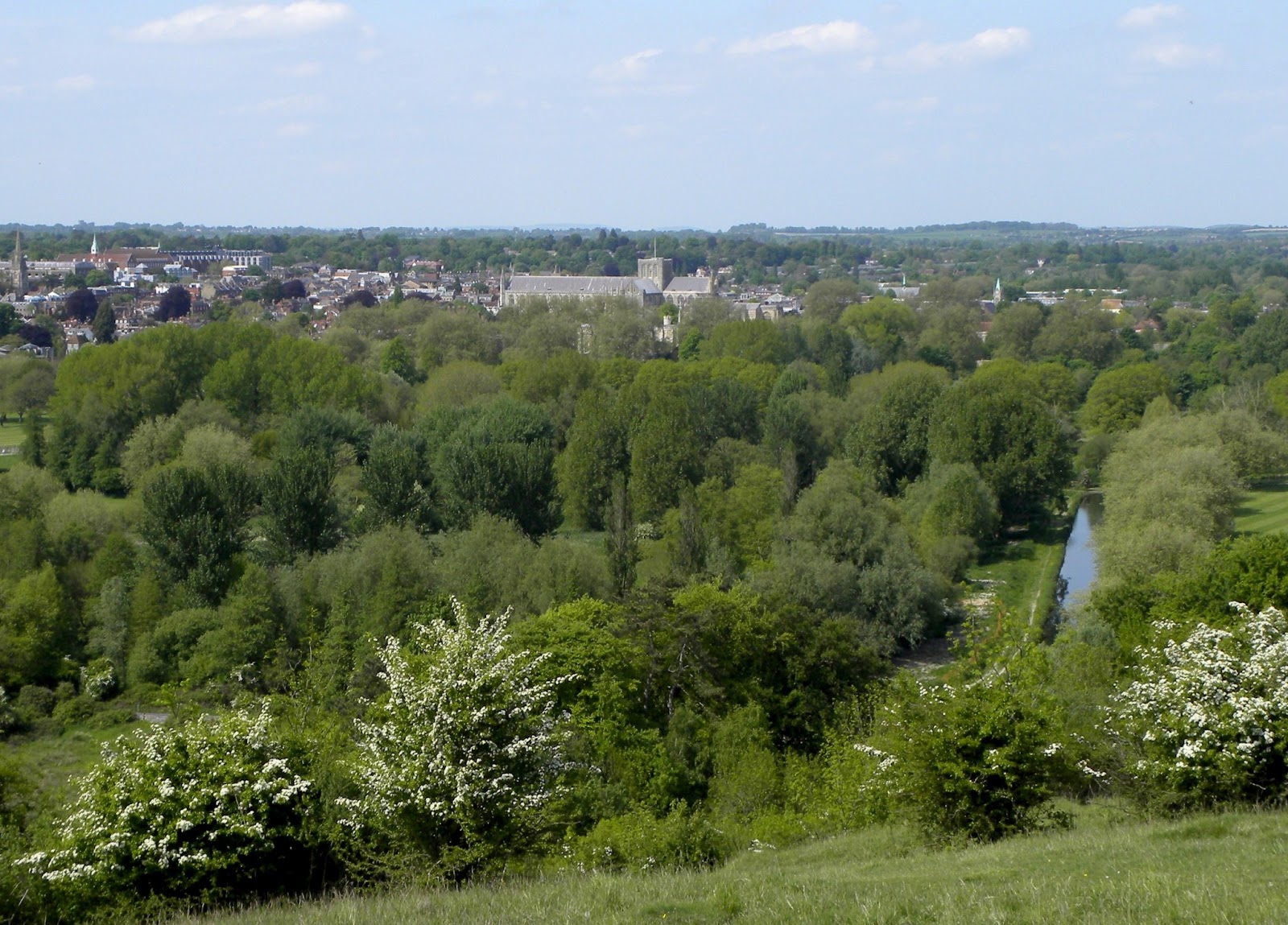
I didn’t take my camera with me for the run up and around St Catherine’s Hill, so here are few shots appropriated from Google images.

The approach to St Catherine's Hill - you can just about see the defensive ditch near the top
The two paths that follow the ditch around the hill.
A view of Winchester from the hill
A view of Winchester Cathedral and the River Itchen